
After The Threat Is Gone
On survival, moral honesty, and what changes when an abuser can no longer reach you.

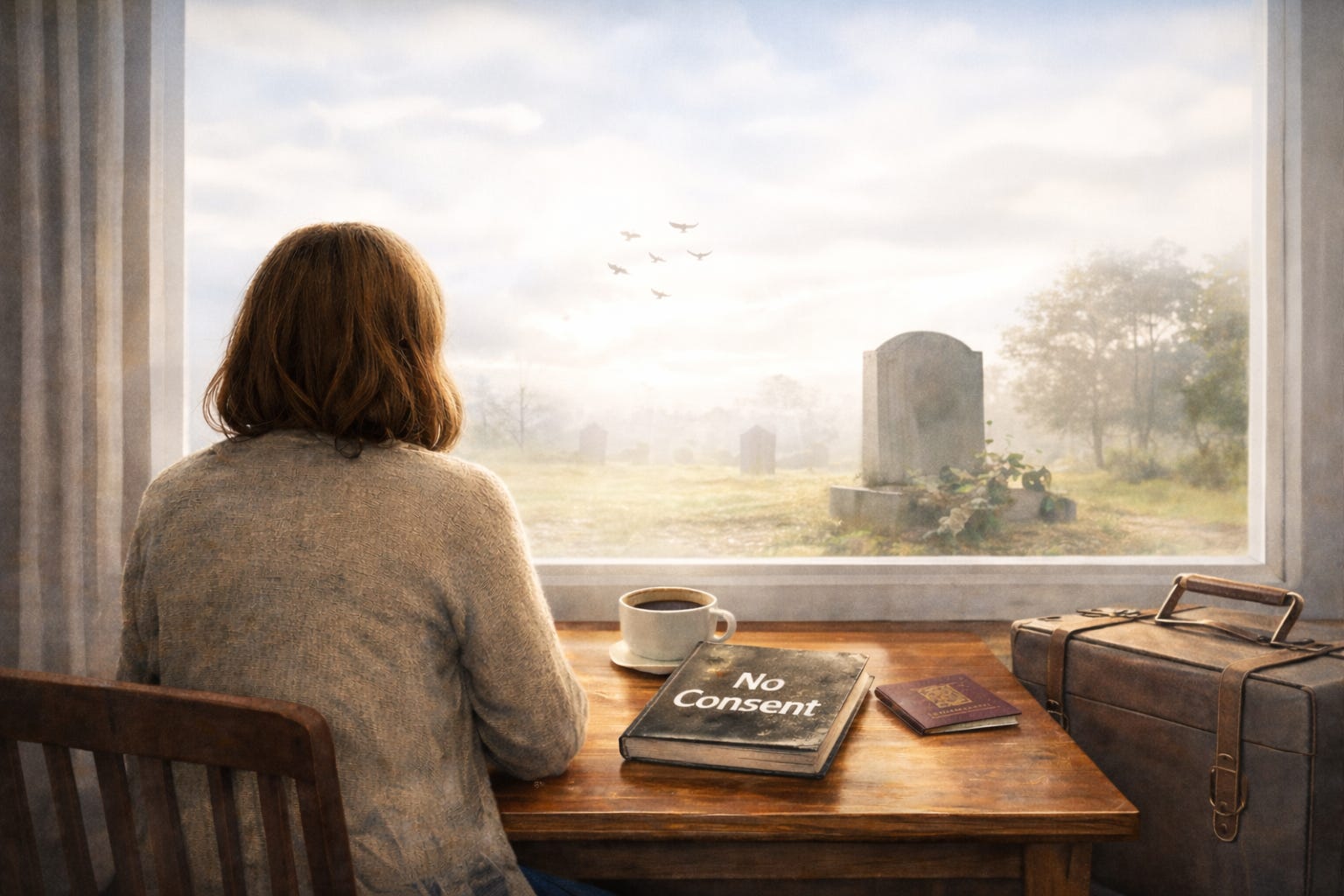
Three days before the end of 2025, I learned that the man who had abused me in 1994 had died.
His death wasn’t peaceful. Following a night at a bar, he came home drunk, fell, vomited, and almost drowned in his own sick. His lungs were likely severely damaged, and he spent just over a month in intensive care before his heart finally gave up.
During that month, they took him off life support for a day or two. He was deeply frightened and struggling to breathe. When his condition worsened again, they connected him to the machines once more.
When I learned of his passing, I didn’t feel shock. I didn’t feel grief. Nor did I feel relief, at least not in the way we imagine relief should feel. There were no emotions, no tears, no sense of closure.
What I felt was more complex, and harder to explain.
The sadness that wasn’t for him
There was some sadness. Not for him, but for his wife.
A year earlier, he had abused her so severely that he nearly killed her, this being the second attempt. As before, he left her for dead, going to a bar to secure his alibi. This time, while she lay bleeding on the floor, she suffered a stroke. She survived, but was left disabled.
She didn’t deserve that life with him. She didn’t deserve that ending.
Though the feeling of sadness was real, it was also factual, rather than overwhelming.
What surprised me the most was not what I felt, but what I didn’t.
Ever since I had left him, I had assumed that the day he died would unlock something inside me. I had expected a shift, a release. Instead, the news landed almost like it was just an administrative act, like a final stamp on an already filed document.
Still, it mattered.
Distance as survival
He hadn’t occupied my daily thoughts for many, many years. It mattered because knowing he no longer walked this earth subtly changed something in my inner world.
I had left him thirty-one years ago because I had to. He had made it clear that he would always find me, wherever I was, and that he would make my life hell. I have no doubt that had I stayed in South Africa, he would’ve done exactly that. After all, I had learned the hard way that when he promised harm, he delivered.
When I fled from his claws, I left everything familiar behind. My country of birth. My language. My friends. My life. I had to start from scratch, with only my mom to lean on. It was my escape. I used the distance as a shield, geography as my last line of defense.
Writing it down so it couldn’t be undone
Shortly after arriving in the Netherlands, I wrote a book about the nine and a half months I had been involved with him.
I needed to put pen to paper to understand how he had groomed me when I was vulnerable after a broken relationship. How he played into my insecurities. How he had manipulated me into sexual encounters involving his wife, and other women, sometimes multiple people at once.
As I write this, my inner critic immediately screams: You could’ve said no!
It took me years — many, many years — to understand: No, I couldn’t. He wouldn’t let me. He framed coercion as choice, humiliation as intimacy. When it suited him, he called me a whore for participating in the very acts he had orchestrated.
I was with them for two months when he assaulted his wife, and a week later, he slapped me across the face. I found excuses for him. I believed I had provoked him. Now I know there is never a reason to abuse another person.
Two months after the slap, he headbutted me so violently, I nearly lost consciousness. He burned me with a cigarette, which left a lifelong scar, thankfully much fainter now than before. Violence was not an exception. It was a tool he used to exert control.
I wrote that book — Without Consent, later renamed No Consent — to document everything that happened. Not for catharsis, but for clarity. It was evidence, not a confession.
The body remembers
Over the years, I edited that book several times. First to have it printed. Years later, I adapted it for my blog. Then, years after that, I edited it again, this time to share it on Medium. That was two years ago. I will share it here on Substack in 2026, but without any further changes.
Between those edits lay long stretches of ordinary day-to-day life. Marriage. Work. Family. Writing other things. I was slowly healing, not only from what happened in the months he controlled my life, but also from other traumas. The healing never announced itself as such — it was and still is an unstoppable process.
Every time I returned to those words I had written in 1995, chills ran up and down my spine. Panic. Fear. Recognition. The words hadn’t lost their charge. My body still knew they were true.
Outside the text, I felt largely indifferent toward the book. I kept a kind of barrier between myself and it. It existed at a distance. Only when I read the actual sentences did the physical response return. The indifference wasn’t avoidance. It was containment. The story lives outside me now, and it’s only when I open it that my nervous system still checks the facts.
When the hum stopped
When I learned of his death, something in that dynamic shifted.
‘Reset’ was my power word for 2025. It was a year in which I weighed everything and let go of what no longer served me. That process had nothing to do with him specifically. It was about healing from a lifetime of accumulated harm: emotional absent parents, manipulation, lies and the quiet ways my life had been steered without my consent.
It was at the very end of this year that the knowledge of his death arrived.
He was gone. Not metaphorically, Not symbolically. No, he was gone in a way that is irreversible.
It felt like the final reset.
For three decades, there had been a background awareness that he still existed somewhere in this world. It wasn’t fear. It was more like a dormant alert system. The fact of his existence carried weight across borders; across continents, no matter how much time had passed.
My body remembered it, even when my mind busied itself with other things.
Now that background hum is gone.
Moral honesty
There is not enough discussion about what it’s like to outlive an abuser, especially when their actions were never legally addressed or publicly acknowledged. It’s expected of survivors either to forgive or to be devastated. There’s very little space for moral neutrality, for calm honesty, or for survivors to be at peace.
I was hesitant to admit, even to myself, a certain satisfaction about his final suffering.
It wasn’t pleasure. Not joy. It wasn’t vengeance. It was satisfaction in the loosest sense, like something finally snapped into balance.
It’s only now, after his passing, that I understand how grotesquely unbalanced the equation had felt. He inflicted terror, humiliation, and physical violence. He continued living, while I carried the after-effects.
Knowing that fear and loss of control marked his final days did not create harm. It did not have any malicious intent. It simply acknowledged that the universe did not grant him an entirely gentle exit.
This is not the same as cruelty.
I didn’t cause or engineer his suffering. I only noticed it.
We often judge how survivors should react when the person who harmed them dies. We’re saying that being ‘good’ means you can only feel pity, or offer a vague forgiveness.
But… it’s not our duty to make someone look good in death when they caused so much pain in life.
I can feel compassion for his wife and feel nothing tender toward him. I’m allowed to acknowledge the injustice.
What I felt was not darkness taking root. It was honesty without censoring myself.
Belonging
For 2026, I chose ‘belong’ as my power word.
I chose it before learning of his death. It came from the same long process of healing that ‘reset’ came from. The timing is important, though, at least to me. It’s like the universe was at work, as the news of his ending arrived just as I prepared to step into something new.
Belonging had always been conditional. Belong, but stay alert. Belong, but always know where the exits are. Even in safety, a part of me always remained vigilant.
True safety isn’t only the absence of immediate threat. It’s also the absence of future possibilities. Possibilities of him reappearing, retaliating, or casting a shadow over my life or my words.
His death removed that possibility.
That book — No Consent — now feels less like a warning, and more like a record of events. It’s something that can now rest on the shelf. Still true. Still mine. But it’s something that’s finally behind me.
To ‘belong’, when applied to this piece of history, doesn’t mean reconciliation with the past. It doesn’t mean forgiveness. I don’t have to soften the truth to make it more palatable.
No, it’s about being true to myself. About trusting my version of events without defending it. It’s allowing my body to register safety without suspicion. It’s about taking up space without apology.
If ‘reset’ was the clearing of corrupted systems, ‘belong’ is what installs afterward.
I don’t know yet what it will look like. Perhaps there will be fewer internal negotiations; fewer moments spent defending myself to a harsh inner critic about what happened all those years ago.
There is one thing I do know: the end of his life doesn’t define mine. It simply closes a chapter that remained open for far too long.
The hum has stopped.
In that quiet, something like belonging becomes more than possible.
Also read this wonderful essay by Diana C.
The Bare Minimum Maintenance

You don’t notice when it happens. It begins with you adding one too many tops to the pile of clothes you’ve left on your chair. They’re folded, but they’re mile…
In my opinion, he got off too easily.
The fear he felt at the end does not even come close to the terror that you and others had to live through.
He was a monster, and I am glad he is gone. The world is a little safer without him. In the last few days, the story has been on my mind, and some moments kept flashing back to me. Iam so grateful that you had the courage to leave. ❤️❤️❤️
I'm amazed, inspired, moved and shaken in the best possible way. Your words feel like a warm hug to anyone who still feels that nervous hum. Thank you so much for sharing, Marie!