
The Little Table That Stayed
The unexpected ways we reclaim ourselves

Find more of my writing for Know Thyself, Heal Thyself here.
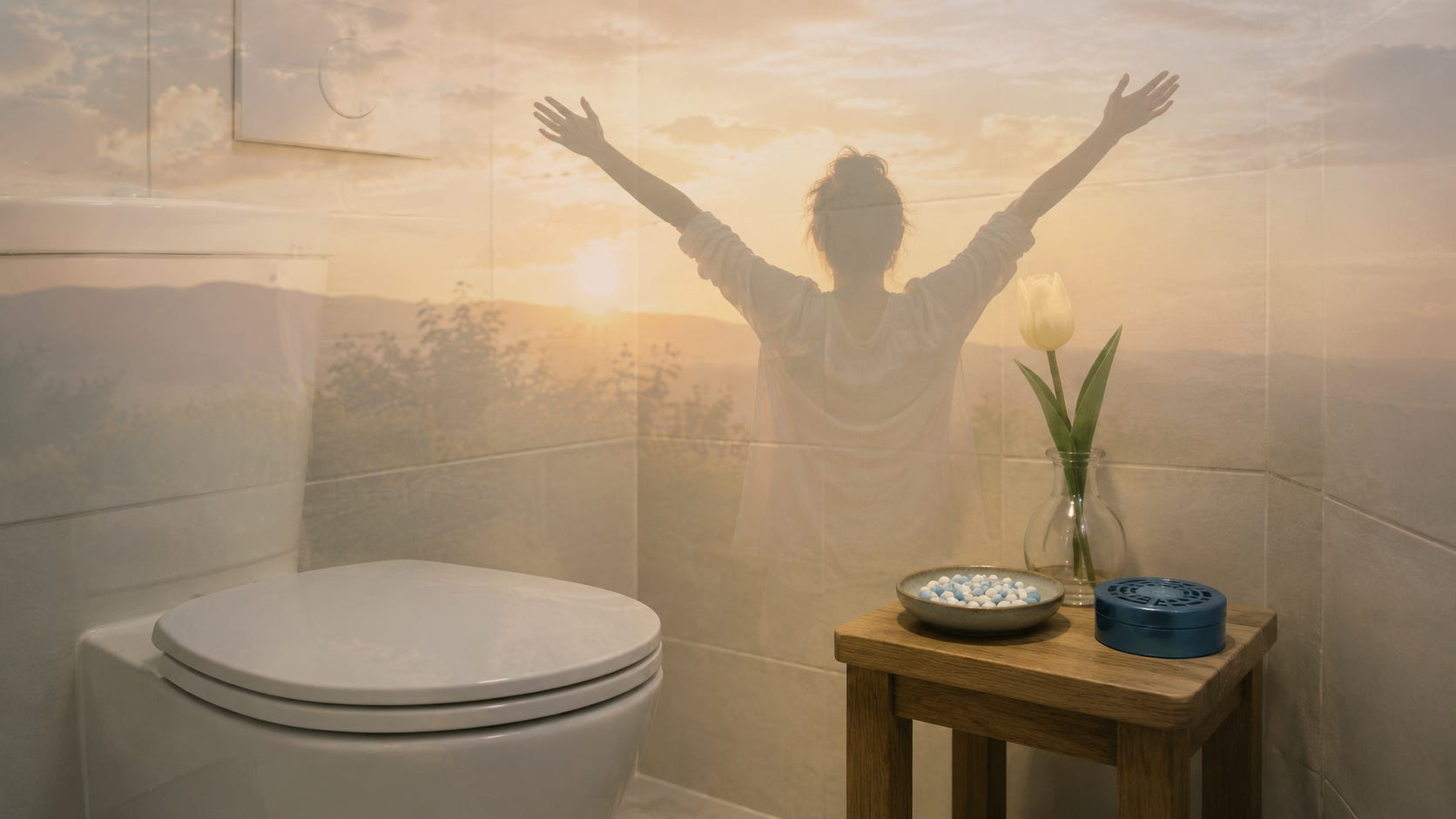
Almost two weeks ago, I put a small table in our downstairs toilet.
Not a fancy table. Just a simple, sturdy, square one. Twenty by twenty centimeters, and twenty centimeters high.
The toilet downstairs has a habit of developing an unpleasant smell. No matter how often I clean it with wonderfully scented products, the freshness never seems to last. The toilet itself sits slightly to the left, leaving a bit of unused space behind it on the right-hand side. For years, that space held a toilet brush and a can of air freshener, both standing directly on the floor.
Then came the day I put that table in there, a special air freshener on top.
That was all.
No major renovations or expensive purchases. Definitely no dramatic life decisions.
Just a little table.
Later that day, my husband went to use the toilet. The door remained slightly open as he stopped, forgetting to pull it closed behind him as usual. I watched him through the crack in the door. He stood there for what certainly was at least thirty seconds, simply looking at the table.
Not touching it.
Not commenting on it.
Just staring.
I sat here laughing silently because I knew this would be his reaction, but wiped the expression from my face before he exited again. I expected a remark later, but nothing came. Even if it had, it wouldn’t have changed anything — the table was there to stay.
A small thing that wasn’t small
If someone had told me twenty years ago that placing a tiny table next to a toilet would feel significant, I would have thought they were being ridiculous.
Yet it did feel significant.
Not because of the table itself, but because of what happened inside me.
For much of my life, I have been someone who asked for permission. Not always out loud, as it often happened only in my head.
Growing up with strict and controlling parents, I learned very early to be careful. To think ahead and gauge their reactions before they’d happen. To consider what they would allow before deciding what I wanted. There were times I’d ask for permission and heard: Don’t be so ridiculous!
Asking for permission became a lesson I carried into adulthood. Even when no one told me explicitly that I needed permission, I assigned people to roles they’d never asked for.
Anyone with a little authority — a manager, a doctor, a coach, even my husband — could quietly end up in what I now think of as the ‘daddy role’.
They had never put themselves there — I did. And once they were in that role, I automatically began seeking approval, waiting for permission, and treating their preferences as more important than my own.
Back in March, I started working on an email to my manager about changing my working hours. I tweaked and tweaked until it was perfect. You see, my first instinct was to ask. To carefully phrase it as a request. To see whether it might be possible.
Then, three weeks ago, I looked at the draft and realised I didn’t want to ask. I had already decided. I knew what I wanted.
Instead of emailing, I informed my manager during our weekly one-on-one meeting that my hours would change from July onward. He accepted it without protest.
I walked away feeling ridiculously proud of myself.
My husband never wanted this obedience from me. From the very beginning of our relationship, he treated me as an equal. He consulted me and involved me in decisions. He never demanded that I ask permission for anything; never expected me to wait for his approval.
The hierarchy existed almost entirely inside my head.
For years, I was reacting not to the man standing in front of me, but to the lessons I had learned decades earlier.
Moving into someone else’s life
The circumstances of our life together might have contributed to that pattern.
When I moved in with my husband in 2004, I didn’t move into a house we chose together. I moved into his childhood home, which his parents had rented when he was only seven years old. It was where he’d grown up, and his elderly and frail mother still lived there when my son and I moved in.
The furniture was already there, and routines already existed. The history belonged to other people. Every weekend I cleaned the house, almost as if ‘paying my dues’ while hoping I did it the way his mother wanted it; the way he wanted it.
Over the years, when his mom moved to a care home, we added our names — his and mine — to the rental contract. We built a life in this house, yet some part of me never completely stopped feeling like I had stepped into a life that was already in progress.
I adapted. I fit myself into the existing structure. Adaptation became so natural that I barely noticed I was doing it.
The question behind the question
Recently, I have been asking myself a recurring question: Who am I really?
Coaching, dreams, life changes, and growing older have all pushed that question to the surface. I found another question underneath that one: What belongs to me?
My preferences, opinions, and choices.
My space, my voice, and my home.
It’s difficult to know who you are when you have spent years unconsciously placing your desires behind everyone else’s.
Perhaps before I can answer ‘Who am I?’ I first need to discover which parts of my life actually belong to me.
Quiet acts of ownership
Looking back, I only now see the small signs. The signs where I gradually started changing some things.
In March 2025, I cut my hair short, despite knowing my husband preferred long hair. I didn’t do it to rebel. I did it because I wanted short hair. Beforehand, I informed him I would do it, and when he asked why I wanted to cut it, my answer was simple: “Because I want to.”
I must’ve startled myself with that definite statement, as I immediately tried softening it by adding that I could always grow it back if I didn’t like it.
In April 2026, I had it cut even shorter.
In 2024, we bought new furniture. For the first time, I took the lead in choosing the dining table, the chairs, the couch, and the side tables. Not that I didn’t like the furniture we bought many years before that, but back then, I just went along with my husband and never questioned myself whether that really was what I wanted.
Earlier this year, we bought beds because I wanted us to be prepared for whatever the future may bring. The beds can be adjusted much like hospital beds, allowing one of us to remain at home should care ever become necessary.
Each of those decisions was small. None of them changed the world, but each one represented a tiny shift away from asking: ‘Am I allowed?’
It moved toward asking: ‘What do I want?’
Taking ownership
The biggest shift arrived when I least expected it.
My husband has been ill for years. As his energy declined, household tasks gradually became more difficult for him. Honestly, part of me resisted stepping in.
Not consciously… no, emotionally.
Why should I clean if he can’t? Surely there are some things he can do? Why should I carry more of the load? Can’t he just do some of the minor tasks he used to do?
The result was predictable. Things remained undone. I cleaned some, but definitely not all. I was a master at procrastinating, and the house became messier. Underneath it all was a quiet protest against a reality I couldn’t change.
Then, just over two weeks ago, something shifted. I remember the exact words that went through my mind: “I’m going to take ownership of my house.”
Not our house. My house.
For the first time since 2004, those words felt true. Not because I was claiming the house from someone else, but because I was finally claiming my place within it.
I stopped waiting. Stopped protesting reality. I stopped hoping circumstances would magically become different.
Newsflash: They won’t!
Instead, I realized that if I wanted a cleaner, more organized home, I would have to create one.
Not because it was fair. Nothing about a partner being ill is fair.
Not because I enjoyed every minute. I most certainly did not.
Because this is where I live. This is my life. This is my home.
And because a memory of my mom popped into my head. Something that had happened about a year before her passing.
My mom had moved a million times. Her last move was the one closest to us, and just after she had decorated the house exactly how she’d wanted it, the same old mantra started: This isn’t good, that needs to be fixed, I don’t know if I want to stay here.
I loved her last home, and wished I had the opportunity to choose the home I want to live in, to decorate it to my taste. So when she started moaning, I might’ve given her a dirty look. For sure, I know I said nothing about it, because remember: my mom was an authority figure in my life.
The next time I visited her, she looked around her, brought the same subject up again, in a roundabout, almost apologetic way. “I decided,” she said, “that I should be happy with what I have.”
Those words popped into my head when the thought came to me that this is my life, my home, my husband, and I have to make the best of it.
Be happy with what you have.
The little table that stayed
I didn’t put the table there because I wanted to challenge my husband. I know he has difficulty with changes, but he was never the obstacle.
The obstacle was the old belief that someone else’s opinion automatically carried more weight than mine.
The table stayed where it was because, for perhaps the first time in a long while, I wasn’t waiting for approval that I didn’t actually need.
A few days later, I bought additional air fresheners, a small dish for scented pearls, and a new toilet seat to replace the old, yellowing one. When I got home, I placed the air fresheners on the dining table.
That evening, while we were getting ready for bed, I caught my husband inspecting the collection. He bent over slightly, studying the labels and trying to figure out what I had brought home.
I was trying very hard not to laugh.
When he spotted me, he straightened up and then asked: “What are you going to do with all this junk?”
It wasn’t the question that bothered me. It was his tone.
Years ago, I would have immediately explained myself. Instead, the words left my mouth before I had time to think about them: “Listen to the tone you’re using when you ask that.”
Then I turned around.
He tried asking again in a friendlier voice, but I continued upstairs. The conversation was over.
The air fresheners stayed where they were. Just like the table. That may not sound like much, but to me, it felt like another victory. Not because I had won an argument.
Because I had stopped assuming I needed to defend every decision I made.
To anyone looking in from the outside, the table is nothing more than a minor household adjustment. A practical solution to an annoying problem.
Yet for me, it became a symbol.
Not of rebellion. Not of independence. Certainly not of refusing to listen to anyone else’s opinion.
It became a symbol of something quieter.
Something healthier.
There was this realization that my preferences also matter. That I don’t need permission for every decision. I understood that I’m allowed to shape the spaces in which I live. The person I needed to convince turned out to be myself.
The table remains exactly where I put it.
Every time I see it, I smile.
Not because it solved a problem. Not because it now holds a tiny vase with a flower and a collection of nice-smelling things.
I smile because it reminds me of something far more important.
Sometimes the first step to reclaiming your life is a tiny square table that quietly refuses to move.
If you enjoyed this article, please consider buying me a coffee…
Find more of my writing here:

Yes - its not about winning over someone else its about standing up for yourself and your self esteem. Interesting piece Marie <3
A beautiful step!