
The Yeontan Winter
On coal briquettes, class, and the cards my father was dealt

When my father met my mother in early spring 1972, he was a street vendor selling apples. A twenty-six-year-old man, too young to be selling produce in a muddy countryside market but too old to be unemployed. Luckily, right after I was born in 1973, he got a job at the Pohang Iron & Steel Company (POSCO), a newly established corporation backed by government funding. The company was eager to recruit employees—thousands of them from all over Korea. In those days, if someone you knew was already working there, you could get in through him. My father’s distant relative, already employed at the plant, provided exactly that opportunity.
His path to the steel company actually began in Bugang, a small town two hundred kilometers from Pohang. His high school was a trade school specializing in bookkeeping and entry-level accounting—nothing to do with mechanics or manufacturing. But six years after his graduation, the school rebranded itself as a mechanics school. Suddenly, my father could claim he’d attended a mechanical school, which qualified him to work as a mechanic at the company.
Through TV, radio, and street posters, the government tried to educate the public about yeontan’s dangers and proper use. But it didn’t matter. When Korea’s freezing, wet cold descended, the poor had no choice but to rely on the black briquette.
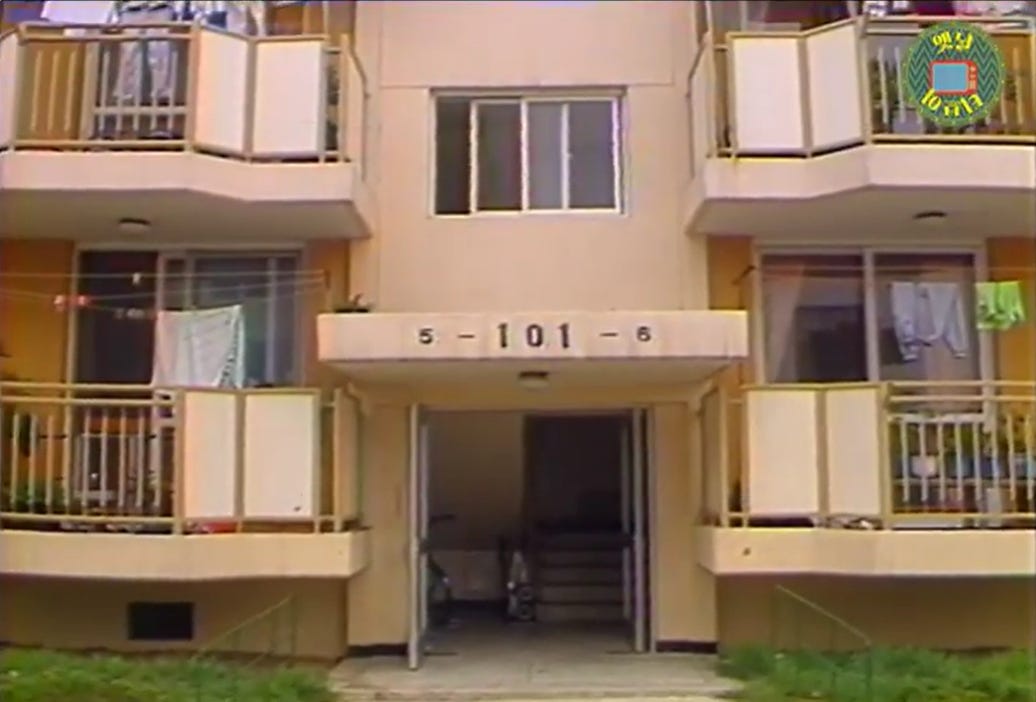
Most employees at POSCO came from other cities and towns. Many had families and needed housing, so the company built a large-scale housing project in Jigokdong, a rural town on the western edge of Pohang. Over time, it transformed into a modern suburban community with apartment buildings, schools, grocery stores, public baths, and a pharmacy, and even a bowling alley and a concert hall.
Our first house in Jigokdong was in Inhwa, a five-story apartment building—one of a few dozen identical buildings. It was a small unit with only two bedrooms, a half bathroom, and a tiny kitchen. In the master bedroom, the glossy black wardrobe with sliding doors, Mom’s makeup vanity, and our TV left only a small space for laying out blankets at night. The second bedroom was even tighter. My father’s green steel desk and green canvas armoire took up most of the room, leaving just enough space for Sori, my younger sister, and me to lie down.
We didn’t have a living room. Instead, a tiny square hallway connected the front door to all the other rooms. The most conspicuous feature, after its peculiar shape and size, was the yeontan hole—a cylindrical, floor-level furnace occupying one corner. Using tongs that resembled giant scissors, we lowered yeontan (coal briquettes) into the furnace, then placed a thinner, already-lit briquette on top to ignite them. The tiny holes in each yeontan—each one the size of an adult’s thumb—had to align so the flame could travel through. Once they caught fire, warmth spread beneath the concrete floor and through the yellow linoleum, gradually heating our small apartment: 13 pyeong, less than five hundred square feet.
However, that warmth came with danger. Every winter, we heard tragic news on TV of entire families who had perished from carbon monoxide poisoning. This gas—odorless and tasteless, heavier than regular air—settled close to the floor, forcing cleaner air upward and suffocating anyone sleeping below, like an invisible pillow pressed against their faces.
Every time my mother told this story, she never failed to mention how my diaper had leaked everywhere. She believed the poisoning had caused it, triggering my cries. Messy as it was, I felt proud that, even as a baby, I had saved my family’s lives.
But yeontan claimed lives in other ways too. For those who had lost hope—bankrupt businessmen, laid-off workers, young men crushed by heartbreak—it offered a final refuge. They would seal their windows or car doors, let the briquette burn beside them, and slip quietly into the unknown.
Through TV, radio, and street posters, the government tried to educate the public about yeontan’s dangers and proper use. But it didn’t matter. When Korea’s freezing, wet cold descended, the poor had no choice but to rely on the black briquette.
My mother often told me how I had saved both my parents’ lives when I was just a few months old. On a freezing winter night, while everyone slept, I began crying with high, desperate wails, as if someone were stabbing me. My father woke to my cries and tried to rouse my mother to check on me, only to find himself nearly paralyzed, a telltale sign of carbon monoxide poisoning.
At the time, we were living in a one-room rental with a door that opened directly to the outside. Fighting through the haze, my father managed to drag himself to the door and, with the last of his strength, flung it wide open, letting the poisoned air escape. He carried me to safety first, then returned for my mother, who was barely conscious.
Every time my mother told this story, she never failed to mention how my diaper had leaked everywhere. She believed the poisoning had caused it, triggering my cries. Messy as it was, I felt proud that, even as a baby, I had saved my family’s lives.
Yet even after we moved to Inhwa, yeontan remained our only option.
But for some, it didn’t have to be.
Even as a child, I resented that my father hadn’t gone to college when other fathers had—especially since it determined which apartment we lived in.
There were two kinds of POSCO employees: the ones with college degrees and the ones without. My father, of course, belonged to the second group, and most employees in that category lived in Inhwa or other similar apartment complexes—two bedrooms, half a kitchen, a nonexistent or tiny living room. Oh, and a bathroom with no bathtub and no hot water tap. If we wanted to shampoo our hair on winter mornings, we had to boil water first.
The first kind, though, lived in a different kind of apartment: three bedrooms, a full-size living room, a full kitchen, and a full bathroom with a bathtub and hot running water. Their apartments were twice the size of ours.
Unlike our yeontan system, where only the floor held heat and the air stayed cold, they had central heating that warmed the entire space, top to bottom. No risk of being poisoned in their sleep, either.
Even as a child, I resented that my father hadn’t gone to college when other fathers had—especially since it determined which apartment we lived in. Yet I knew he was working hard for us, laboring near the giant blast furnace at the steel mill, kept at thousands of degrees to melt iron ore and scrap steel, so dangerous that a few workers died every year. I was grateful for him, though I wondered if he felt grateful for his own circumstances.
Like most young Korean men, my father and his coworkers had completed three years of military service before joining POSCO, where former generals and colonels sat in leadership roles. The military culture transferred into the workplace, even down to the employees’ work uniforms—fatigues, boots, and hard hats. I can still picture my father taking a full minute to lace up those boots before work, and another minute to unlace them when he returned home. Some of my friends from Inhwa told me that supervisors on the floor physically reprimanded their workers for poor performance: slapping faces or kicking shins.
In that harsh, high-pressure environment, my father must have been under immense stress, some of which he brought home. For the next twenty years, until his children grew up and left, his stress manifested in every corner of his life, ruining his relationship with his wife, his children, and himself. Yeontan was a symbol of what a poor man like my father had to endure—the harsh Korean winter, the circumstances. The cards that he was dealt.
In that harsh, high-pressure environment, my father must have been under immense stress, some of which he brought home.
Nowadays, yeontan is something of a novelty. To younger people, it is a distant, interesting old-timer’s story, like an artifact in a museum. Some restaurants use it to enhance the flavor of their grilled meat. A few artists use it to convey an atmosphere, the messy, the gritty, the forgotten. All from a safe distance, unlike the poorest who still burn yeontan to keep the razor chill at bay, elderly people living in the most neglected corners of Seoul, where crumbling structures still stand, always under threat of being bulldozed. The forgotten place most Koreans don’t know exists. The kind of place where I lived growing up.
I am a memoirist writing about growing up in 1980s and 90s in Korea. This piece is excerpted from my serialized memoir, The Steelmaker's Daughter.
If you'd like to follow along, subscribe here.
I think this is a great project you have taken on - sharing your heritage - I will subscribe to you - and when i have time keep up with the stories from your past
So hard, interesting, anxiety producing, beautiful. Everything.