
The Things That Follow Us
Sometimes healing means putting down the tools that once helped us survive.

Find more of my writing for Know Thyself, Heal Thyself here.
A few nights ago, I snapped out of a weird dream at half-past two in the night. As I went to the bathroom, the images stayed with me. I thought by the time I woke up in the morning, I would’ve forgotten them all, but it was still as clear in my mind as if the dream had just happened.
It turned out to be one of those dreams that stays with you long after waking. Not because it was loud or dramatic, but because of the feeling it left behind — something that settled deep inside me and refused to be dismissed.
In the dream, I was in a car with my mother and one of my children. Oddly, I could not tell whether it was my son or my daughter. We were fleeing from someone. Even that person was unclear. At moments it felt like my father; at others, it felt like a man I was involved with in 1994, a relationship marked by fear, manipulation, and abuse.
Details shifted, but the feeling didn’t.
Danger.
Urgency.
I had a desperate instinct to escape before something terrible happened.
My mother was driving while I kept looking over my shoulder. I urged her to go faster, convinced someone was following us. At one point, I just knew that person would shoot at us. Instinctively, I pushed my hand down over my child’s head, shielding them before the shot even came.
Then I looked behind us.
There was a perfectly round bullet hole in the rear window.
No sound. No shattered glass. No explosion.
Just a small, precise hole.
That image stayed with me after waking because it felt strangely symbolic. A bullet hole should bring chaos with it. Cracks spreading outward. Noise. Damage impossible to ignore. But this window remained intact, as though the violence had passed through silently, leaving behind only evidence that something had happened.
Then the dream changed.
Suddenly, it was only my daughter and me.
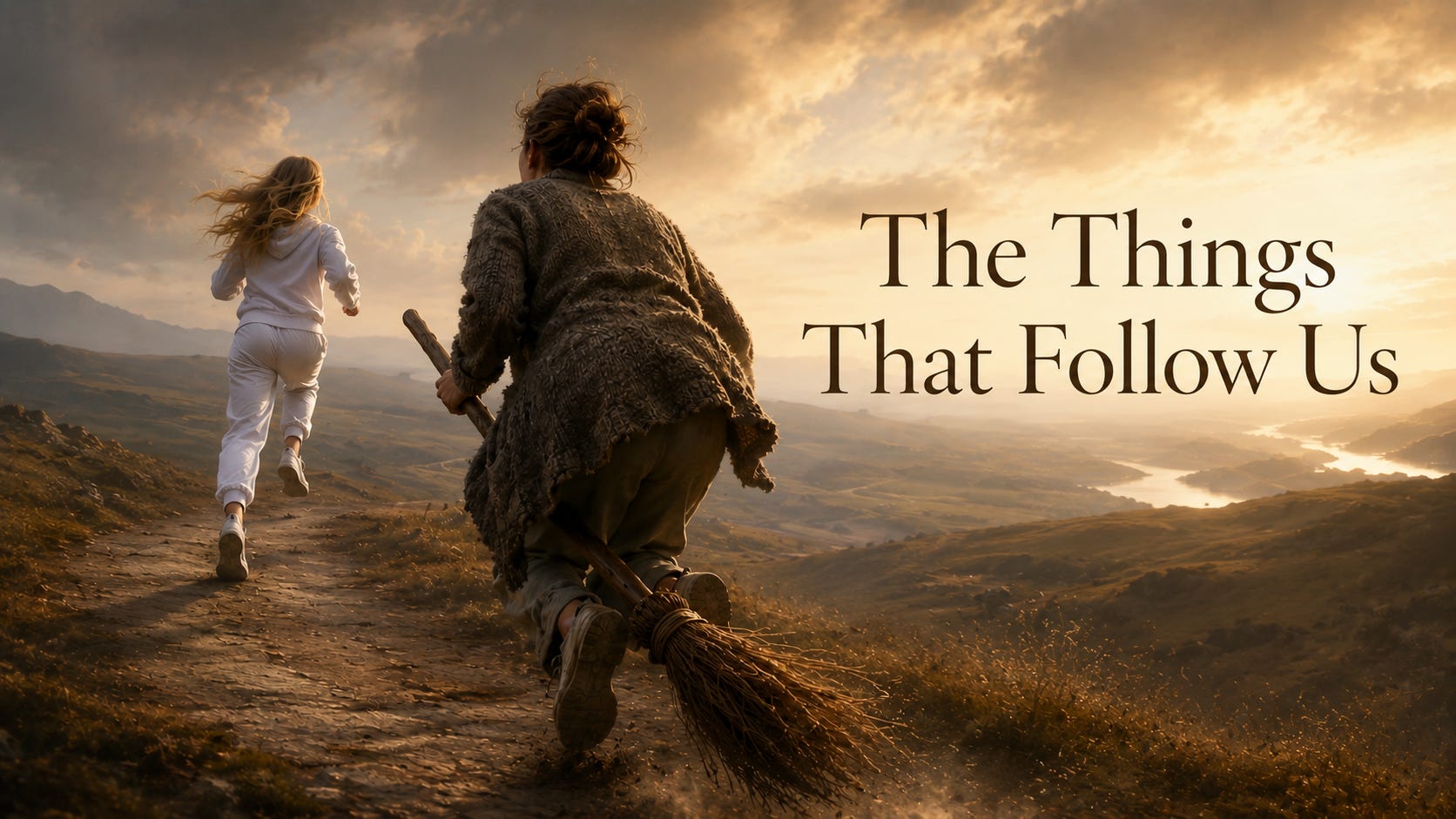
Again, her age was unclear. She seemed both younger and older, suspended somewhere between child and adult. She was dressed entirely in white sportswear with white sneakers. Even stranger, her hair was blonde, though in real life it is dark. Despite these changes, I knew unquestionably that she was my daughter.
She was running because we were still escaping something, though now the threat itself was invisible.
While she ran, I was trying to move forward on an old, worn grass broom. Not flying gracefully like something from a fairy tale, but awkwardly propelling myself forward by bouncing and springing on it as though it contained some strange hidden recoil.
I kept falling behind.
I would push harder, almost catch up to her, then lose ground again.
Meanwhile, she kept urging me onward, telling me to go faster.
The more I reflected on the dream afterward, the more it seemed to mirror something I have increasingly begun understanding about mental health, healing, and survival.
Many people think trauma is only about the moments when terrible things happen. But often, trauma lives just as deeply in anticipation. It lives in a state of constantly scanning for danger. In becoming hyperaware of moods, voices, footsteps, silences.
It’s like preparing for impact before it arrives.
That instinct revealed itself in the dream. Before the shot, before any visible damage appeared, I had already shielded my child.
The body learns survival long before the conscious mind catches up.
Survival mechanisms are complicated things.
We often view them negatively, as though coping mechanisms are weaknesses to overcome or flaws to eliminate. But the truth is far more nuanced than that.
Many of the coping mechanisms we later struggle to unlearn once saved us. Hypervigilance, emotional suppression, people-pleasing, overfunctioning, anticipating danger, staying small, staying quiet, constantly scanning the emotional temperature of a room — these are not random defects.
They are adaptations.
Survival skills.
They are the mind and body doing whatever they must do to get someone through experiences that felt unsafe, unpredictable, or emotionally overwhelming.
The problem is not that these mechanisms develop.
The problem is that the nervous system often doesn’t realize the danger has changed.
So we continue surviving situations that no longer hold us captive.
We keep bracing for impacts that are not coming.
We continue reacting to old ghosts as though they are standing directly behind us.
That is what the bullet hole in the dream came to represent for me: invisible wounds. The kind that leaves little outward evidence while still changing the way someone moves through the world.
From the outside, a person can appear functional, resilient, capable, even strong. The glass still looks intact.
But something pierced through.
And healing from that is rarely straightforward.
Because healing is not simply about ‘moving on’. It is about slowly teaching the body and mind that the survival strategies which once protected us may no longer be necessary in the same way.
That is incredibly difficult.
Especially when those mechanisms have become woven into identity itself.
If hypervigilance kept you safe, how do you suddenly stop scanning for danger?
If emotional detachment prevented collapse, how do you suddenly allow yourself vulnerability?
If over-functioning ensured survival, how do you learn to rest without guilt?
The old broom in the dream felt deeply connected to that idea.
A broom is a tool of labor. Maintenance. Cleaning up messes. Quiet endurance. Traditionally, it’s also tied to women’s work — the invisible work of carrying households, emotions, responsibilities, and often entire generations on exhausted shoulders.
My broom in the dream was old and worn, yet I was still using it to propel myself forward.
Perhaps that is exactly what healing sometimes feels like.
Trying to build a new life using tools created during survival mode. Trying to move freely while still relying on coping mechanisms formed in fear. Also, trying to catch up to a version of life that feels lighter, freer, healthier — while still unconsciously returning to old patterns whenever stress, fear, or uncertainty appears.
That is one of the most frustrating parts of healing: realizing that growth is not linear. Sometimes we believe we have moved beyond certain behaviors or emotional responses, only to slip back into them during difficult moments.
Not because we have failed.
Not because the healing was fake.
But because those pathways were carved deeply over years, sometimes decades.
The nervous system always returns first to what it knows, even when what it knows is exhausting.
Still, there was also something hopeful in the dream.
In the first part, I protected my child. In the second part, my daughter encouraged me forward.
That reversal feels important.
Perhaps healing is not only about protecting the next generation from what harmed us. Perhaps it is also about allowing ourselves to be pulled forward by them — by love, by connection, by the possibility that life can become softer than what came before.
My daughter, dressed completely in white, felt almost symbolic of that possibility. Not perfection, not purity in some unrealistic sense, but perhaps a different emotional inheritance. A life less governed by fear. A life less shaped by survival.
Part of healing is allowing ourselves to believe that we deserve that too.
Even if we still stumble. Even if we still return to old patterns. Yes, even if we are still riding battered old broomsticks while trying to keep pace with a freer version of ourselves.
Because healing is not the absence of old survival mechanisms.
It is the gradual recognition of them. The gentle unlearning of them. The conscious decision, again and again, to choose safety when the body expects danger.
Maybe that is why the dream continues to linger with me.
Not because it was frightening, but because somewhere inside it, I recognized myself. A woman still moving forward with worn-out tools. Still trying. Still healing.
Still learning that surviving and living are not the same thing.
Also read this powerful essay by Noor Vellin, also about a telling dream:

This is such a great post to read for those who are healing and wondering why its taking so long - and I agree about being pulled forward by our kids as adults. Mine say they have learned from my life. And suddenly just that makes my mistakes ok lol if they don't repeat them, then i am glad i made them
"Perhaps healing is not only about protecting the next generation from what harmed us. Perhaps it is also about allowing ourselves to be pulled forward by them." This has been my life, even though I still dream the bad dreams (but not as often as before, after starting to write them down here, surprisingly). Watching my children living their lives free of what I endured makes it all worth it.
Thank you for sharing. 💕🙏